The end of the year is often a time of reflection, gratitude, and generosity. People look back on what they have accomplished and find themselves wanting to pay it forward by giving to organizations and causes they are passionate about. In a year of great change, American donors are trending towards being more generous in 2025 than in the previous year, showcasing the heart Americans have for giving. While causes, motivations, and amounts may change from year to year, one thing is certain: more Americans give during the holiday season than any other time of the year.
Seeing changes in donor behavior can provide insight to those looking to give on where they might concentrate more of their giving this year, or for non-profit organizations, it may help provide greater opportunities to reach American donors at such a pivotal time of giving. With that in mind, CAF America has taken a look at Americans’ generosity so far in 2025 compared to 2024 to share the state of giving in America and anticipated behaviors during the 2025 holiday season.
Methodology
The 2025 portion of this research is based on 1,105 survey responses from U.S. adults. This data was collected by Centiment on behalf of CAF America between October 21 and October 29, 2025, using Centiment’s online panel. The sample is nationally representative of U.S. adults and weighted to Census demographic information for age, gender, age by gender, income, and region (margin of error is ±4%).
Median respondent: 47-year-old with a household income of $75,000-99,999 and $50,000-74,999 in investable assets (not including homeownership).
Concentration of Giving
Holiday spirit is an amplifier for sharing, caring, and giving every year. Half (51%) of U.S. adults report having donated or planning to donate money by the end of 2025, with a fifth of those donating exclusively in the final months of the year. That would be a noticeable drop from 2024 – in CAF America’s World Giving Report: Giving in the U.S., we estimated that 61% of U.S. adults donated money in 2024 as a whole. However, our new research finds that the typical donor is projected to give double the amount per month during November and December than the previous year (~$100/month in 2025, ~$50/month in 2024), meaning that even as fewer Americans say they plan to give, those who do are stepping up with greater generosity, especially during the holiday season.
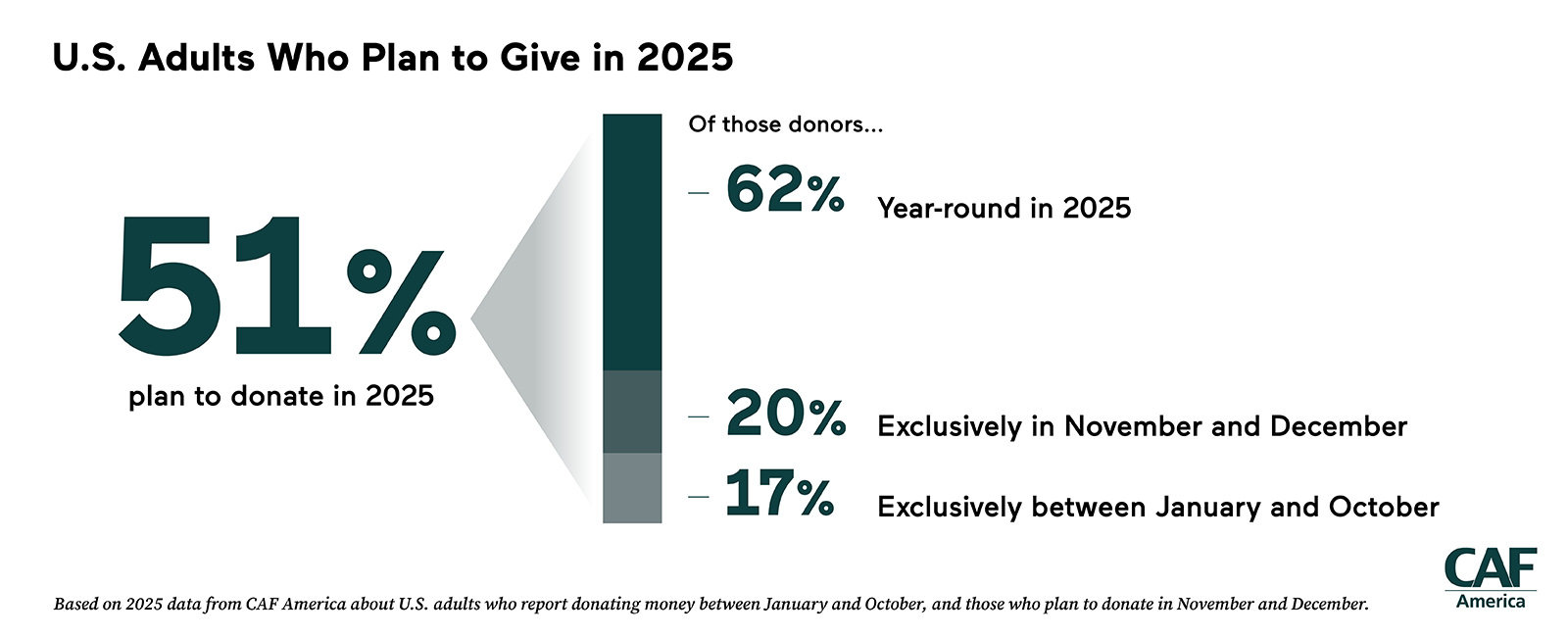
While financial constraints remain the main reason some Americans did not and do not plan to make a monetary donation this year, there seems to be greater interest in giving in 2025 than last year: 51% of those who didn’t donate considered doing so in 2025 compared to 31% in 2024.
There has also been a shift in the age demographics of American donors for 2025. While adults ages 65+ are more likely to be donors than any other age group (60% vs. 48%), donors under 50 are more likely to donate exclusively during the holidays compared with those 65+ (27% vs. 13%). On average, roughly half of charitable giving by adults under 50 is during this time. This is comparable to 2024 for those under 30, but a shift towards prioritizing the end-of-year season for those ages 30-49.
Cause Areas
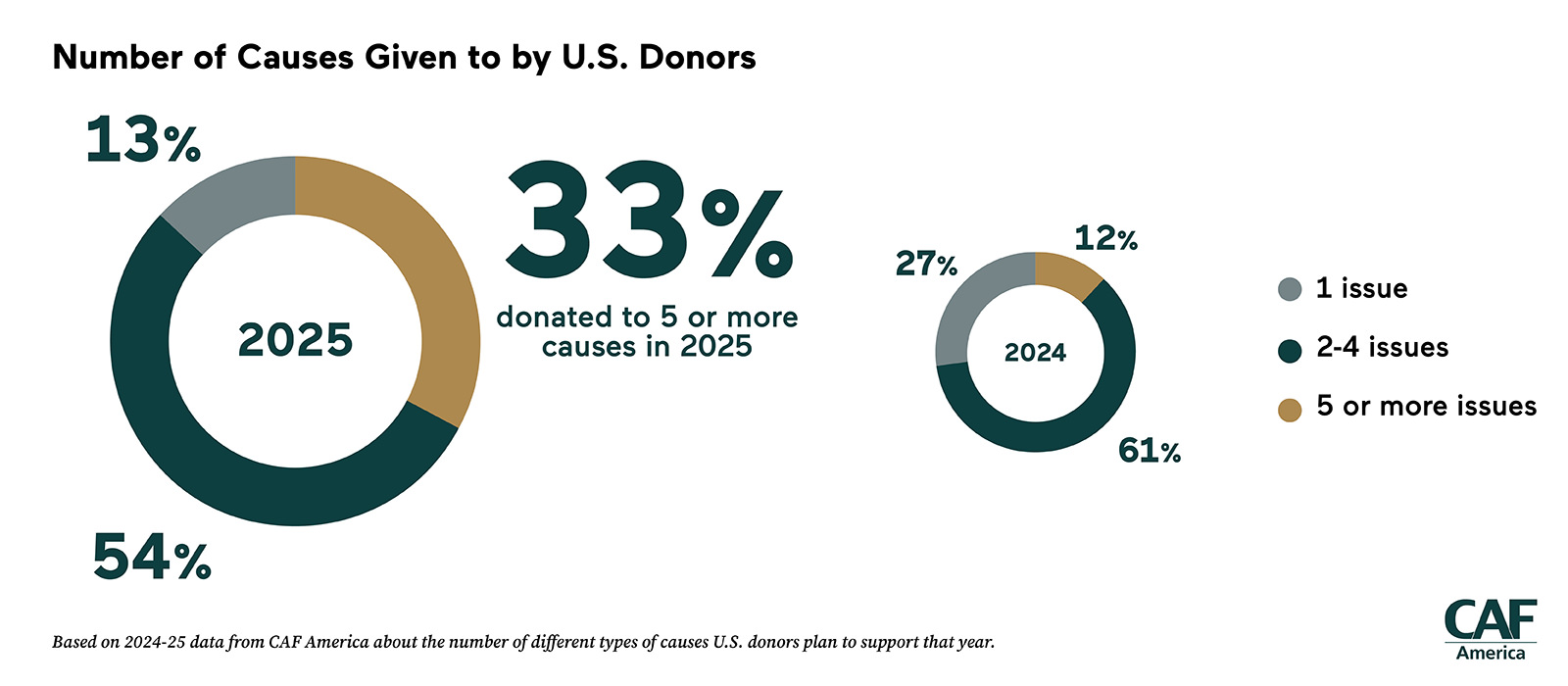
American donors are supporting more cause areas this year as well, focusing on 3-4 rather than 2-3, and the percentage of donors supporting 5+ causes more than doubled (12% in 2024 to 33% in 2025). The share supporting just one cause dropped from 27% in 2024 to 13% in 2025.
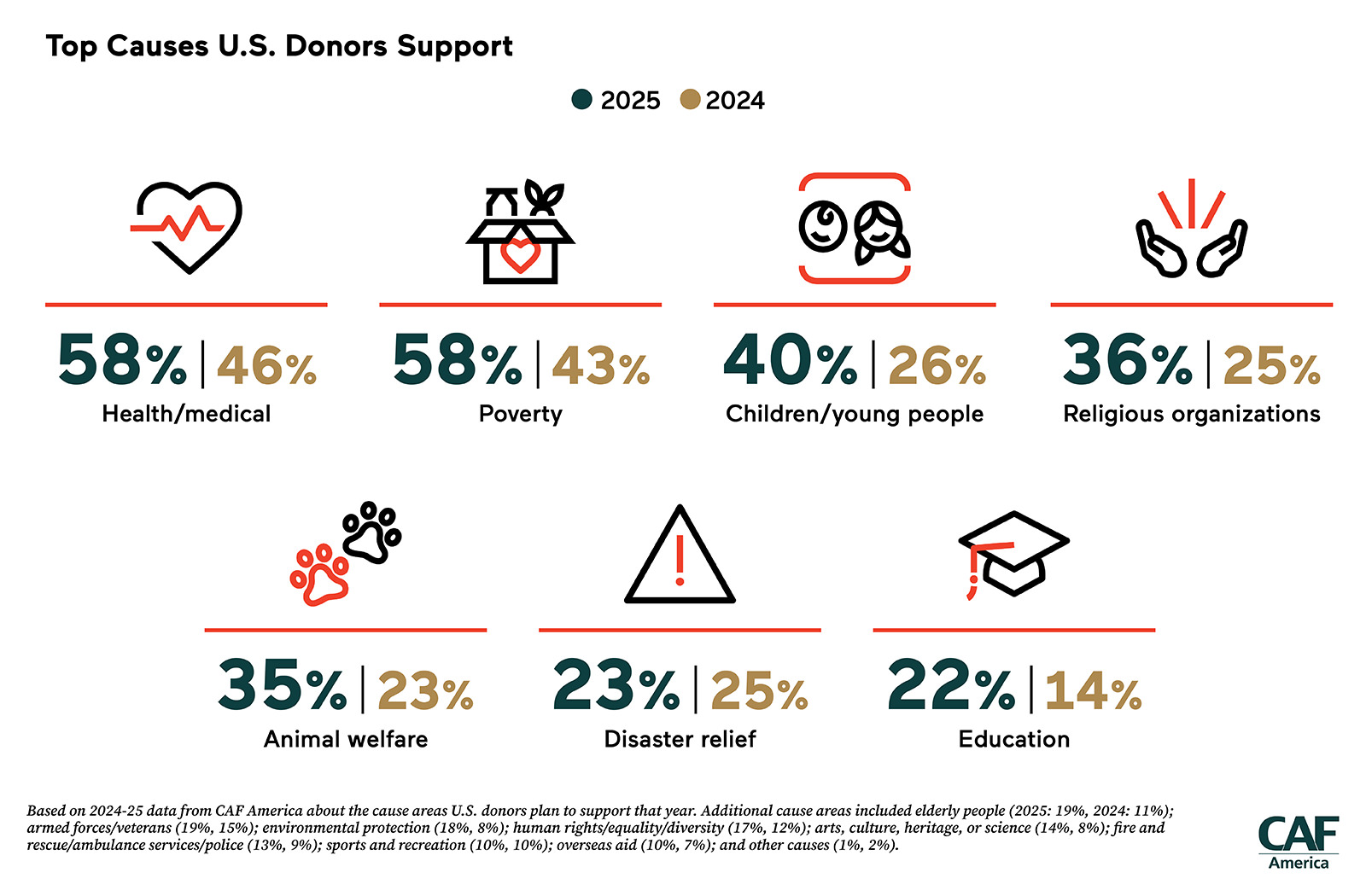
Health and poverty remain the top areas of concern for American donors in 2025. While the number of donors has decreased for 2025, the shares donating to the top cause areas have increased, with the greatest growth from the previous year in donations dedicated to poverty.
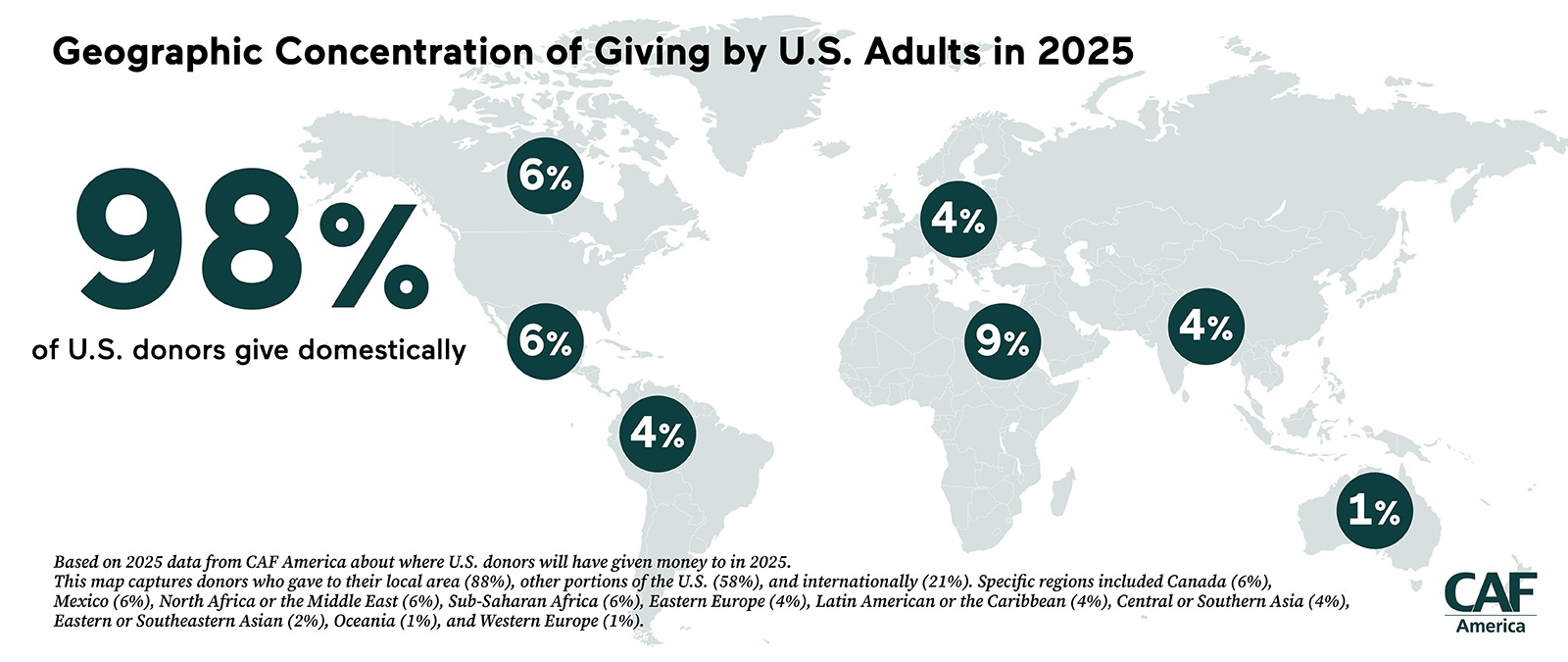
While U.S. donors are still heavily focused on domestic causes, especially those in their local area, those looking to support international causes rose from 12% in 2024 to 21% in 2025. Meanwhile, the proportion of giving that these donors put toward international causes has decreased from last year (39% vs. 52%).
- 98% U.S. (Domestic)
- 88% Their local area
- 21% International (any)
Choosing Causes for Giving
With so many great causes and organizations to give to across the globe, how are Americans choosing where to give? Trusted sources such as previous donations, personal experience, and referrals remain the core ways donors find their causes. The top four methods for choosing a cause have remained the same. Overall, 89% of U.S. donors use at least one of these methods to choose where to donate money.
- 54% Previously donated
- 50% Personal experience
- 36% Through friends or family
- 34% Researching the cause
News coverage played a bigger role in Americans’ philanthropic decisions this year, with a 10% increase compared to the previous year (15% in 2024 to 25% in 2025). In this year’s research, CAF America also extended our list of potential sources of inspiration for choosing where to donate to include social media (23%) and advisers (9%).
Key Takeaways
This year’s data makes one thing clear: even as fewer Americans say they plan to give, those who do are stepping up with greater generosity, especially during the holiday season. Donors are supporting more causes, giving higher amounts, and showing renewed interest in both local and global causes. For nonprofits, understanding these shifts in donor behavior can unlock more meaningful engagement and stronger impact throughout the 2025 holiday season and beyond. And for donors, these insights offer a chance to better understand their own giving habits, identify the causes they care about most, and make more intentional decisions as they navigate the remainder of the year.
More Resources
- Discover additional end-of-year resources on our End-of-Year Giving Insights Hub
- Download our End-of-Year Fundraising Toolkit
- Learn What Makes a Good Story to strengthen engagement with your donors
- Review the 2025 World Giving Report on Giving in the U.S.